


TL;DR:
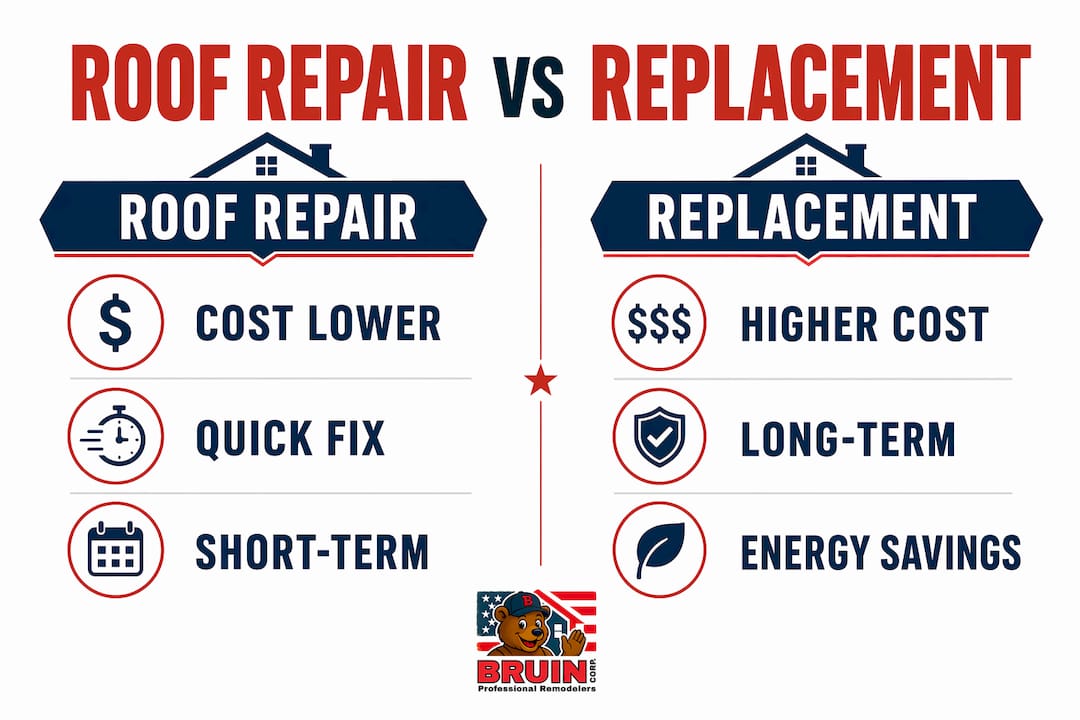
- Repair is suitable for roofs under 15 years old with less than 30% damage, costing less than a full replacement. Replacement is recommended when a roof exceeds 20 years of age, has damage over 30%, or incurs repair costs above 30-50% of replacement cost. Calculating cost per remaining year and considering insurance discounts help determine the most cost-effective choice.
Roof repair is defined as fixing isolated damage on a structurally sound roof, while roof replacement means removing and reinstalling the entire roofing system. The decision between the two comes down to three measurable factors: your roof’s age, the extent of damage, and cost-effectiveness relative to a full replacement. Get these wrong and you either overspend on a new roof you didn’t need, or you pour money into repairs that buy you six months before the next leak. This guide gives you the exact thresholds, cost frameworks, and real-world scenarios to make the right call.
What conditions indicate roof repair is the right choice?
Repair is the correct choice when your roof is under 15 years old and damage covers less than 10–30% of the total surface area. The 30% cost rule reinforces this: if your estimated repair cost stays below 30% of what a full replacement would cost, repair is the smarter financial move. That threshold exists because repairs beyond that point signal a temporary fix on a roof that is already failing.
Repairable damage typically includes:
- Cracked or missing flashing around chimneys, skylights, or vents
- A small patch of wind-lifted or broken shingles covering one section
- Minor granule loss on a few shingles without widespread blistering
- Isolated leak points traced to a single penetration or seam failure
Repair costs usually range from $300 to $1,500 for asphalt roofs, compared to $9,000 to $15,000 for a full replacement. That gap makes repair the obvious choice for localized problems on a younger roof.
Local building codes also shape your options. Some jurisdictions limit how many times you can re-shingle over existing layers before requiring a full tear-off. Your insurance policy matters too. Many carriers cover storm damage repairs fully, which makes repair essentially free out of pocket when damage is limited.

Pro Tip: If you have had two or more repairs in the past three years, you are likely in a “repair-and-repeat” cycle. Each patch fixes one spot while the rest of the aging roof continues to deteriorate. Track your repair history and total spending before scheduling another fix.
When should homeowners consider a full roof replacement?
Replacement becomes the right answer when the roof’s age, damage scope, or cumulative repair costs cross specific thresholds. A roof that is 20 or more years old is a strong candidate for replacement, even if visible damage appears limited. Older asphalt shingles become brittle and prone to recurring leaks that no single repair can stop.
The clearest replacement signals are:
- Roof age over 20 years with widespread granule loss, curling shingles, or sagging decking
- Damage covering more than 30% of the roof surface or spreading across multiple slopes
- Cumulative repair costs exceeding 30–50% of replacement cost over the past few years
- Multiple repairs in the last 3–5 years, which points to systemic failure rather than isolated incidents
- Structural damage to the decking beneath the shingles, which repairs cannot address
Some local building codes mandate replacement when damage affects more than 25% of the roof surface area. That means the choice is sometimes made for you by code, not just by cost.
Replacement also opens the door to energy-efficient materials. Cool roofs and metal roofing reduce peak cooling demand by 10–15%, saving $150 to $250 annually for typical homes in warmer climates. That annual savings compounds over the life of the new roof, improving the total return on your investment well beyond what the sticker price suggests.
Repeated patch repairs on older roofs frequently lead to escalating costs and a shorter overall roof lifespan. Systemic damage requires replacement, not another round of targeted fixes.
How to calculate cost-effectiveness: cost per remaining year
The cost-per-remaining-year method is the most practical framework for comparing repair and replacement. Divide the total project cost by the number of years of service you expect to get from the roof. A lower number wins.
Example: A $1,200 repair on a 10-year-old asphalt roof with 15 years of life remaining costs $80 per year. A $12,000 replacement on the same roof, now expected to last 25 years, costs $480 per year. Repair wins clearly in this scenario.
Flip the numbers for an older roof. A $1,500 repair on a 22-year-old roof with only 3 years of life remaining costs $500 per year. A $12,000 replacement lasting 25 years costs $480 per year. Replacement is now the better value, and that is before accounting for insurance savings or energy efficiency.
Adding a 15–20% buffer to repair costs on roofs past 75% of their lifespan accounts for the near-certainty of follow-up repairs. That buffer often tips the math decisively toward replacement.
Insurance savings make replacement even more attractive. Many insurance carriers offer 15–25% premium discounts for Class 4 impact-resistant shingles or metal roofing. In hail-prone states, those discounts can reach 25–30%. The ROI from replacement derives more from risk reduction and energy savings over the roof’s lifespan than from immediate dollar recoup at sale.
| Material | Avg. Replacement Cost | Annual Energy Savings | Insurance Discount | Net Benefit Over 20 Years |
|---|---|---|---|---|
| Standard asphalt shingles | $9,000–$12,000 | Minimal | None typical | Baseline |
| Class 4 impact-resistant shingles | $11,000–$14,000 | Moderate | 15–25% premium reduction | Significant |
| Metal roofing | $14,000–$20,000 | $150–$250/year | 15–25% premium reduction | Highest long-term |
| Cool roof coating | $3,000–$6,000 | $150–$250/year | Varies by carrier | Strong for warm climates |
Pro Tip: Ask your insurance agent for a written quote on premium changes before you choose a roofing material. That number belongs in your cost-per-remaining-year calculation, not as an afterthought.
How do roof repair and replacement affect home value and resale?
A new roof removes the single biggest structural concern buyers raise during home inspections. New roofs enable smoother, faster sales by eliminating buyer price negotiation pressure and preventing repair requests that can kill deals at the last minute. That is not a small advantage in a competitive market.
The financial return is real but not dollar-for-dollar. A new roof typically recoups 56–72% of installed cost on resale. That means a $12,000 replacement adds roughly $6,700 to $8,600 in appraised value. The remainder of the return comes through faster sales, fewer concessions, and cleaner inspection reports.
Key considerations for homeowners planning to sell:
- Selling within 2–5 years with minimal damage: Repair is likely sufficient if the roof has years of life remaining
- Selling with a roof over 20 years old: Buyers and their inspectors will flag it; replacement protects your asking price
- Timing a replacement: Install 1–3 months before listing to show a fresh roof without rushing the project
- Negotiation leverage: A worn roof gives buyers a documented reason to demand price cuts; a new roof removes that leverage entirely
A new roof does more than protect your home from rain. It protects your sale price from negotiation. Buyers use every visible defect as a reason to offer less. A roof that passes inspection without comment is worth more than the inspection report shows.
Exploring partial re-roofing as a budget-friendly middle ground
Partial re-roofing, also called slope or section replacement, replaces only the most damaged portions of a roof rather than the entire surface. It costs less upfront than a full replacement and more per square foot than a full job, but it targets the worst areas without touching slopes that still have years of life left.
Partial replacement makes sense when:
- One or two slopes are severely damaged while others remain structurally sound
- The remaining slopes have 8 or more years of life left, making full replacement premature
- Budget constraints make full replacement impossible this season
- A phased approach spreads costs over two or three years without leaving the home unprotected
The tradeoffs are real. Partial slope replacements often cause color mismatch between old and new shingles, and they do not eliminate the need for a full replacement eventually. Treat partial re-roofing as a financially practical bridge, not a permanent solution. If the remaining slopes are within five years of end-of-life, a full replacement now will almost always cost less in total than two separate projects.
Key Takeaways
The most financially sound approach to repairing vs replacing a roof combines the cost-per-remaining-year calculation with roof age, damage scope, and insurance impact to reach a clear, defensible decision.
| Point | Details |
|---|---|
| Use the 30% cost rule | If repair exceeds 30% of replacement cost, replacement is the better financial choice. |
| Age is the primary signal | Roofs over 20 years old rarely benefit from repair; replacement addresses systemic failure. |
| Calculate cost per remaining year | Divide total project cost by expected service years to compare repair and replacement directly. |
| Factor in insurance discounts | Class 4 shingles and metal roofing can reduce premiums by 15–25%, improving replacement ROI. |
| Partial re-roofing is a real option | Replace only damaged slopes when others have 8 or more years of life remaining. |
What I’ve learned after watching homeowners make this call
The most common mistake I see is homeowners treating roof repair as the conservative choice. It feels safer to spend $800 on a patch than $13,000 on a new roof. But on a 19-year-old asphalt roof, that $800 repair is not conservative. It is expensive procrastination.
The cost-per-remaining-year metric changes the conversation completely. Once you run those numbers honestly, including the 15–20% buffer for likely follow-up repairs on an aging roof, the math usually points clearly in one direction. The problem is that most homeowners never run the calculation. They react to the immediate leak instead of evaluating the total cost of ownership.
The other thing I would push every homeowner to do is coordinate with their insurance agent before choosing a material. The insurance premium benefits of impact-resistant materials are significant and consistently underestimated. A $2,000 premium difference in material cost can pay for itself in three to four years of reduced premiums. That changes the replacement decision entirely.
Get a professional inspection before committing to either path. A contractor who only does repairs will recommend repairs. A contractor who does both will give you a more complete picture. Bruin Corp of Attleboro offers inspections that assess both options honestly, which is the only starting point that makes sense.
— Jess
Bruin Corp of Attleboro: professional roofing for Massachusetts and Rhode Island homeowners
Bruin Corp of Attleboro has completed over 11,000 home exterior projects across Massachusetts and Rhode Island, with roofing at the center of that work. Whether your roof needs targeted leak and storm damage repair or a full energy-efficient roof replacement, Bruin Corp brings 40 years of hands-on experience to every inspection and installation.
The team evaluates your roof’s age, damage extent, and material options to give you a clear recommendation grounded in cost-effectiveness, not upselling. Financing options are available, and every project is backed by the craftsmanship that has made Bruin Corp of Attleboro one of the most trusted names in New England home improvement. Request your inspection today and get a straight answer on whether repair or replacement is right for your home.
FAQ
What is the 30% cost rule for roofing?
The 30% cost rule states that if your repair estimate exceeds 30% of the cost of a full replacement, replacement is the better financial decision. Repairs beyond that threshold typically signal a temporary fix on a roof that is already failing.
How long does a typical asphalt shingle roof last?
Most asphalt shingle roofs last 20–25 years under normal conditions. Roofs past 15–20 years become brittle and prone to recurring leaks that repairs cannot reliably stop.
Does a new roof increase home value?
A new roof recoups 56–72% of installed cost on resale and removes the structural concerns that give buyers negotiation leverage during inspections.
When does partial re-roofing make sense?
Partial re-roofing makes sense when one or two slopes are severely damaged and the remaining slopes have 8 or more years of life left. It costs less upfront but does not eliminate the need for a full replacement eventually.
Can a new roof lower my insurance premiums?
Yes. Many carriers offer 15–25% premium discounts for Class 4 impact-resistant shingles or metal roofing. In hail-prone states, those discounts can reach 25–30%, which significantly improves the long-term return on a replacement investment.
Recommended
- #1 Roofing Installation Company Near You | Bruin Corp
- Why Should I Replace My Home Windows? – Bruin Corporation of Attleboro
- Do You Know When It’s Time Replace Your Windows? Use These Simple Tips, Before It’s Too Late! – Bruin Corporation of Attleboro
- Replacement Door Installation in RI & MA | Exterior & Entry Doors | Bruin Corp.