


TL;DR:
- Installing new siding significantly boosts a home’s curb appeal and resale value, especially when energy-efficient materials are used. Proper preparation, correct installation, and routine maintenance are essential for maximum durability and financial return. Choosing the right material and color for your climate and style ensures long-term satisfaction and cost savings.
Upgrading siding is the most direct way to improve your home’s appearance and increase its market value in a single project. The industry term for this work is exterior cladding replacement, though most homeowners simply call it a siding upgrade. Fiber cement siding returns 88%–114% of replacement costs at resale, while vinyl returns 80%–97%. Those numbers mean a siding renovation pays back more than almost any other exterior project. Beyond the financial return, new cladding signals a well-maintained home to every buyer who drives past. Bruin Corp of Attleboro has completed over 11,000 projects across Massachusetts and Rhode Island, and siding upgrades consistently rank among the highest-impact changes homeowners make.
How to upgrade siding and improve home appearance: what you need first
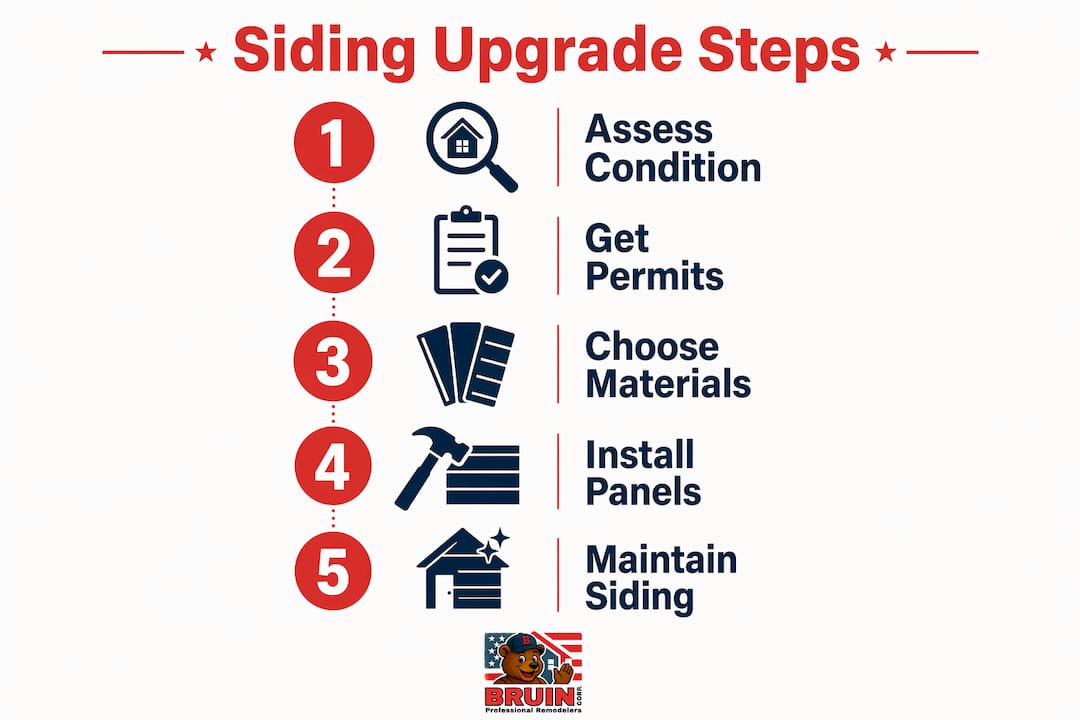
A successful siding project starts before a single panel goes up. Skipping the preparation phase is the most common reason projects run over budget or fail inspection.
Assess your existing siding condition
Walk the perimeter of your home and look for warping, rot, loose panels, and water stains below windows. Failing to remove old siding risks sheathing damage and voided warranties, so document every problem area before calling a contractor. Siding removal adds $0.70–$2.00 per square foot to the project cost. That line item often explains why two quotes for the same job look very different.
Common siding materials at a glance
Each material brings a different trade-off between cost, durability, and maintenance:
- Fiber cement (e.g., HardiePlank): lifespan of 40–50 years, non-combustible, excellent in freeze-thaw climates, requires painting every 10–15 years
- Vinyl: low maintenance, wide color range, cost-effective, can warp in extreme heat without proper installation
- Engineered wood (e.g., LP SmartSide): strong structural performance, lower carbon footprint than fiber cement, requires periodic touch-ups to maintain warranty
- Insulated vinyl: built-in foam backing, R-values between 2.0 and 5.0, reduces heating and cooling costs by 10%–20%
Pre-installation checklist
Before work begins, pull the required building permits for your municipality. Confirm your contractor will install a weather-resistive barrier (WRB) behind the new panels. Check whether your existing walls have a polyethylene vapor barrier, because that detail affects which siding products are safe to use.
How do you choose siding materials and colors to maximize curb appeal?
Material choice and color selection work together. Getting one right while ignoring the other produces a home that looks unfinished or dated.
Match material to your climate zone
Fiber cement is the top choice in freeze-thaw climates because it resists moisture absorption and does not combust. In hot Southern climates, light-colored metal and vinyl reduce cooling load by 20%–30% compared to dark cladding. New England homeowners, who face both cold winters and humid summers, get the best long-term performance from fiber cement or insulated vinyl. Bruin Corp of Attleboro works specifically in Massachusetts and Rhode Island, where freeze-thaw durability is non-negotiable.
Color selection tips that actually work
Color affects perceived home size, neighborhood fit, and resale speed. Lighter neutrals (warm whites, soft grays, greige tones) read as larger and photograph well for listings. Darker shades (charcoal, deep navy) add visual weight and work best on homes with strong architectural lines. Avoid colors that clash with your roof material. Your trim color should contrast with the field color by at least two shades to define the home’s edges clearly.
- Use the 60-30-10 rule: 60% field color, 30% trim, 10% accent (shutters, door)
- Test large paint chips against your roof and foundation in both morning and afternoon light
- Check neighborhood covenants or HOA rules before committing to bold colors
Pro Tip: Order physical siding samples in your top two color choices and hold them against your home’s north and south walls on the same day. Natural light changes color perception dramatically between sun-facing and shaded walls.
Mixing textures for visual depth
Flat lap siding on the main body paired with a contrasting shingle or board-and-batten accent on gable ends adds architectural interest without a full redesign. This technique works especially well on Colonial and Cape Cod styles common across Massachusetts. Read Bruin Corp of Attleboro’s guide on choosing siding materials and colors for more detail on pairing textures with trim profiles.
What are the key steps to installing or replacing siding correctly?
Installation quality determines whether your new siding lasts 15 years or 50. Wrong nail placement or ignored expansion gaps create moisture intrusion risks and visible buckling within a few seasons.
- Remove old siding completely. Tear off all existing panels down to the sheathing. Inspect for rot, mold, or pest damage before proceeding. Replace any compromised sheathing boards.
- Install the weather-resistive barrier. Wrap the entire wall surface with a code-compliant WRB such as housewrap or building paper. Overlap seams by at least 6 inches and tape all penetrations around windows and doors.
- Add continuous rigid foam insulation. Continuous rigid foam behind siding is the single biggest energy efficiency factor in the entire project. It costs approximately $2–$3 per square foot but prevents thermal bridging through wall studs, which standard batt insulation cannot address.
- Install starter strips and corner pieces. These set the alignment for every row above. A crooked starter strip produces a crooked finished wall.
- Fasten panels with correct nail type and spacing. Drive nails into the center of nail slots, not the edges, to allow thermal expansion. Fiber cement requires corrosion-resistant nails; vinyl requires aluminum or hot-dipped galvanized.
- Fit trim, soffits, and J-channel. Trim pieces seal the gaps at windows, doors, and corners. Poorly fitted trim is the most common entry point for water.
- Inspect every penetration. Check around electrical outlets, hose bibs, and vents. Caulk with a product rated for exterior use and compatible with your siding material.
Pro Tip: Never nail vinyl siding tight. Leave a 1/32-inch gap between the nail head and the panel face. Vinyl expands and contracts with temperature, and a tight nail causes the panel to buckle or crack within one heating season.
How does siding maintenance protect your investment and lower energy bills?
New siding does not maintain itself. Even low-maintenance siding requires periodic cleaning to prevent biological growth and dirt accumulation that degrade both appearance and material integrity.
Routine cleaning schedule
Wash vinyl and fiber cement siding once a year with a garden hose and a soft-bristle brush using mild detergent. Avoid pressure washers above 1,500 PSI on vinyl, which can force water behind panels. Engineered wood siding needs inspection every spring for paint film failures, because exposed wood fiber absorbs moisture and swells.
Energy efficiency gains from insulated siding
Insulated vinyl siding delivers R-values of 2.0–5.0, cutting heating and cooling costs by 10%–20%. That reduction shows up on utility bills within the first full year. Pairing insulated vinyl with continuous rigid foam behind the panels compounds the savings further. Bruin Corp of Attleboro’s insulated vinyl siding options are designed specifically for the New England climate, where both winter heating and summer cooling costs are significant.
The vapor barrier risk you cannot ignore
Installing insulated vinyl siding over walls that already have a polyethylene vapor barrier creates a double-vapor-barrier condition. Moisture gets trapped between the two layers, leading to hidden wall rot that can cost far more to repair than the original siding project. Always have a professional assess your wall assembly before choosing insulated vinyl.
When to repaint or touch up depends on the material. Fiber cement paint typically lasts 10–15 years before it needs refreshing. Engineered wood warranties often require repainting on a schedule specified by the manufacturer. Skipping that step can void the product warranty entirely.
Key Takeaways
Upgrading your siding improves home appearance, boosts resale value, and cuts energy costs when you choose the right material, install it correctly, and maintain it on schedule.
| Point | Details |
|---|---|
| Material ROI varies significantly | Fiber cement returns 88%–114% at resale; vinyl returns 80%–97%, making both strong investments. |
| Climate drives material choice | Fiber cement leads in freeze-thaw climates; light-colored vinyl reduces cooling load by 20%–30% in hot regions. |
| Continuous insulation beats siding choice alone | Rigid foam behind siding prevents thermal bridging and delivers the largest energy savings of any single upgrade step. |
| Vapor barrier check is non-negotiable | Insulated vinyl over an existing polyethylene barrier traps moisture and causes hidden rot; always assess wall assembly first. |
| Maintenance protects warranties | Engineered wood and fiber cement require scheduled cleaning and repainting to keep manufacturer warranties valid. |
What I’ve learned after watching hundreds of siding projects succeed and fail
The single most underrated decision in any siding project is not the material. It is the insulation strategy behind the panels. Homeowners spend weeks comparing fiber cement versus vinyl, then skip the continuous rigid foam because it adds a few thousand dollars to the budget. That trade-off almost always costs more in the long run through higher utility bills and reduced comfort.
My other strong opinion: engineered wood siding deserves more attention than it gets. It offers the warmth and texture of real wood without the rot vulnerability, and its carbon footprint is lower than fiber cement. For a New England Colonial or a craftsman bungalow, it reads as authentic in a way that vinyl simply cannot replicate.
The hardest conversation to have with homeowners is about ownership horizon. Buying siding more durable than your expected ownership period often means overspending without proportional return. If you plan to sell in five years, premium fiber cement with a 50-year lifespan is not the right financial call. A quality vinyl installation with strong curb appeal will serve you better.
Professional installation is not optional for most homeowners. The technical details, nail slot tolerances, expansion gaps, WRB lapping, and vapor barrier compatibility, require experience that a first-time DIY project rarely delivers. Premium siding signals a well-maintained home to buyers, but only when it is installed without visible defects. One crooked row or a poorly caulked window frame undercuts the entire investment.
— Jess
Bruin Corp of Attleboro: professional siding upgrades for Massachusetts and Rhode Island homeowners
Bruin Corp of Attleboro brings over 40 years of exterior remodeling experience and more than 11,000 completed projects to every siding job. The team handles material selection, permits, tear-off, insulation, and installation as a single coordinated process, so nothing falls through the cracks between trades.
Whether you are weighing vinyl siding options for a low-maintenance upgrade or considering fiber cement for long-term durability, Bruin Corp of Attleboro matches the material to your home’s architecture, your climate, and your budget. Financing options are available, and every project is backed by the craftsmanship that has made Bruin Corp of Attleboro the go-to siding installation company in MA and RI. Request your assessment and get a clear plan before any work begins.
FAQ
What siding material has the best return on investment?
Fiber cement siding returns approximately 88%–114% of replacement costs at resale, making it the top performer. Vinyl follows closely at 80%–97% and costs less upfront.
How much does a full siding replacement cost?
Full replacement costs range from $6,500 to $27,500 depending on material choice and home size. Tear-off of existing siding adds $0.70–$2.00 per square foot to that total.
Does new siding actually lower energy bills?
Insulated vinyl siding with R-values of 2.0–5.0 reduces heating and cooling costs by 10%–20%. Adding continuous rigid foam insulation behind any siding type compounds those savings further.
How do I choose the right siding color?
Match your field color to your roof and foundation tones, then choose a trim color at least two shades lighter or darker for contrast. Test physical samples against both sun-facing and shaded walls before ordering.
How often does siding need maintenance?
Vinyl and fiber cement need annual cleaning to prevent biological growth. Fiber cement paint lasts 10–15 years before repainting, while engineered wood may require touch-ups on a manufacturer-specified schedule to keep the warranty valid.